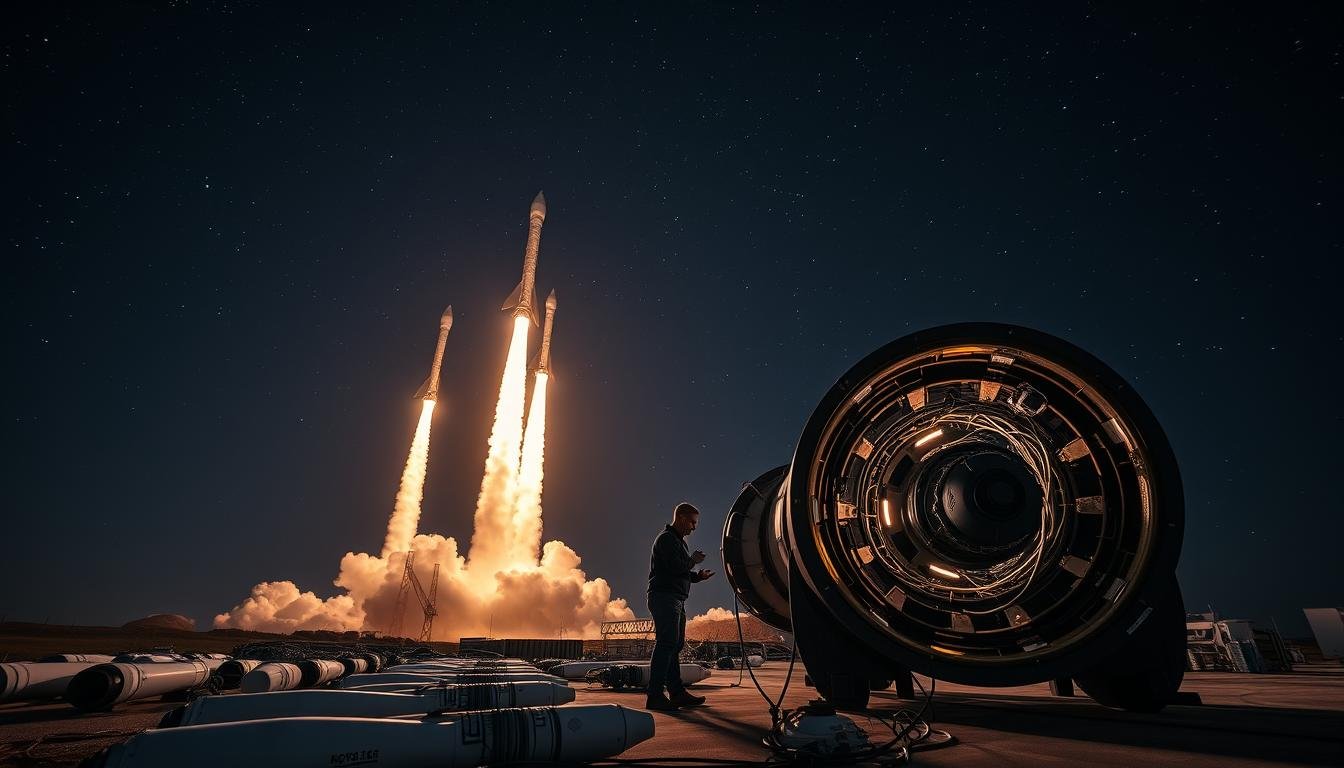
The space industry is changing fast with new innovative rocket technologies. This makes space travel more accessible than ever before.
Recent breakthroughs in rocket technology have cut the cost of accessing space. This allows for more frequent launches and a wider range of uses.
A new era of space exploration is starting, with affordable space travel becoming real. This change will deeply impact the space industry. It will open up new chances for scientific research, commercial ventures, and more.
Key Takeaways
- The cost of accessing space is decreasing due to advancements in rocket technology.
- A new era of space exploration is emerging with more frequent launches.
- Affordable space travel is becoming a reality, enabling a wider range of applications.
- The space industry is expected to undergo significant changes.
- Innovative rocket technologies are making space travel more accessible.
The High Cost Barrier of Traditional Space Travel
Space exploration has faced a big problem: the high cost of launching payloads into orbit. This financial hurdle has limited the number of space missions. It affects both government agencies and private companies.
Historical Launch Costs per Kilogram
The cost of launching payloads into space has always been very high. In the early days, the costs were so high it was hard for groups to get into space. Even with better technology, the costs were still too high for many.
For example, launching a payload into Low Earth Orbit (LEO) cost tens of thousands of dollars per kilogram. The high costs were due to the complex rocket technology and the need for special materials and labor. Only a few could afford to launch payloads into space, making access even harder.
Limitations of Expendable Rocket Systems
Traditional space launch systems use expendable rockets. Each launch needs a new rocket, which raises costs a lot. Making these rockets involves a lot of material and labor, making each launch very expensive.
These rockets can’t be reused or fixed for future launches. This makes launching into space even more costly. It’s a big reason why space launches are not more frequent or affordable.
Economic Constraints on Space Exploration
The high costs of traditional space travel have put a big economic strain on space exploration. The cost of launching payloads limits the number of missions. This slows down scientific discoveries and the development of space technologies.
Also, the high costs affect the growth of the commercial space industry. It’s hard for new companies to compete because of the high launch costs. This limits innovation and investment in space-related technologies.
New Rocket Tech Making Space Travel Cheaper
New rocket technologies are changing space travel by making it cheaper. These innovations are cutting down the costs of launching payloads into space.
Reusable First Stage Rocket Systems
Reusable first-stage rocket systems are a big step forward. Companies like SpaceX have led the way with their Falcon 9 and Starship. By reusing the first stage, launch costs drop a lot.
Reusable rockets have shown they can make launches cheaper. For example, SpaceX’s Falcon 9 has launched many times, using the same first stage.
Advanced Propulsion Technologies
Advanced propulsion technologies are also key. They include new engines and systems that are more efficient and cost-effective.
Methane-Based Engines
Methane-based engines are being developed as a cheaper and greener option. They are better for the environment and could save money.
Electric Propulsion Systems
Electric propulsion systems are becoming popular. They use electricity to propel, which is better for long missions in space.
Innovative Manufacturing Methods
Rocket manufacturing is also changing. Innovative manufacturing methods like 3D printing and automated lines are making production faster and cheaper.
3D Printing of Rocket Components
3D printing makes complex parts quickly and with less waste. It’s faster and allows for designs that traditional methods can’t do.
Automated Production Lines
Automated lines are making rocket making more efficient. They cut down on labor costs and make production more consistent.
Miniaturization and Mass Production
The trend towards miniaturization and mass production is also lowering costs. Smaller satellites need smaller launch vehicles, which are cheaper to make and launch.
This miniaturization trend is letting more companies join the space industry. It’s driving more innovation and lowering costs.
Key Players Revolutionizing Affordable Space Access
The space industry is changing fast, thanks to companies like SpaceX. They are making space travel cheaper. Their new ideas are moving the industry forward.
SpaceX and the Falcon9/Starship Revolution
SpaceX is leading with reusable rockets like Falcon9 and Starship. The Falcon9 can launch payloads and return to Earth for reuse. The Starship aims to go even further, aiming for the Moon, Mars, and more.
Blue Origin’s New Shepard and New Glenn
Blue Origin is also making waves with New Shepard and New Glenn. New Shepard is for short space trips, making space tourism possible. New Glenn is for bigger missions, aiming to cut launch costs with reusable tech.
Rocket Lab and Small Satellite Launch Solutions
Rocket Lab focuses on launching small satellites with its Electron rocket. It offers flexible and frequent launches for smaller payloads. Rocket Lab uses new tech and focuses on cost to make space access easier.
Emerging Startups and International Competitors
New startups and global competitors are joining the space race. They’re bringing fresh ideas and products to the table. This competition is lowering costs and expanding what’s possible in space.
| Company | Key Technology | Focus Area |
|---|---|---|
| SpaceX | Falcon9, Starship | Reusable Rockets, Lunar/Mars Missions |
| Blue Origin | New Shepard, New Glenn | Suborbital Flights, Orbital Launches |
| Rocket Lab | Electron | Small Satellite Launches |
Economic and Practical Implications of Lower Launch Costs
Lower launch costs are changing the game for space travel. Now, more businesses and groups can explore space. This change is affecting many areas of the space industry.
Growth in the Commercial Space Industry
The commercial space industry is booming thanks to cheaper launches. More companies can send satellites and other payloads into space. This leads to new ideas and services. SpaceX and Blue Origin are at the forefront of this trend.
Satellite Deployment Economics
Launching satellites is now more affordable. This opens the door for more businesses to join the market. Lower costs help companies provide global internet and Earth observation services.
| Company | Launch Cost Reduction | Impact on Business |
|---|---|---|
| SpaceX | Up to 70% reduction | Increased launch frequency, expanded services |
| Blue Origin | Up to 50% reduction | Enhanced competitiveness, new customer acquisition |
Space Tourism Becoming Accessible
Space tourism is taking off, thanks to Virgin Galactic and Blue Origin. Cheaper launches mean more people can go to space. This is starting a new industry.
Scientific Research and Exploration Opportunities
Lower launch costs also boost scientific research and exploration. Scientists can now send more missions to space. This helps us learn more about the universe.
The drop in launch costs is transforming the space industry. It’s driving growth, innovation, and exploration. As technology improves, we’ll see even more breakthroughs in the future.
Conclusion: The Future of Affordable Space Travel
The space industry is changing fast, thanks to new rocket tech. Now, affordable space travel is within reach. Reusable rockets and advanced systems are making it cheaper to go to space. Companies like SpaceX and Blue Origin are leading this change with their innovative tech.
As space travel costs drop, the future of space exploration looks bright. More missions are planned, and the space industry is growing. Space tourism and satellite use are getting better, opening up new areas for research and discovery.
This progress will benefit the world, creating new chances for growth and discovery. It’s clear that affordable space travel is soon to become a reality, not just a dream.
FAQ
What is the main factor contributing to the decrease in space travel costs?
New rocket technologies are the main reason. This includes reusable rockets, better propulsion, and new ways to make rockets.
How do reusable rocket systems reduce the cost of space travel?
Reusable rockets make each launch cheaper. They can be used over and over, so you don’t need a new rocket for every flight.
What role do companies like SpaceX and Blue Origin play in making space travel more affordable?
SpaceX and Blue Origin lead the way with reusable rockets. They’re making new systems like Falcon9 and Starship, and New Shepard and New Glenn. These are cutting costs.
How do advanced propulsion technologies contribute to cost reduction?
New propulsion tech, like methane engines and electric systems, is more efficient. This makes space travel cheaper.
What impact do lower launch costs have on the commercial space industry?
Lower costs are growing the commercial space industry. More companies can launch satellites. This makes launching satellites more affordable.
How are innovative manufacturing methods, such as 3D printing, affecting the cost of rocket production?
3D printing and other new methods are making rockets cheaper. They speed up production and allow for more rockets to be made.
What opportunities are emerging as a result of lower launch costs?
Lower costs are creating new chances for space research, exploration, and tourism. More people and groups can now explore space.
Are there any new players entering the space launch market?
Yes, new startups and international companies are joining. They bring fresh ideas and competition, which lowers costs further.